

How to Know If You’re Ready to Sell Options With Real Money (5-Point Self-Test)
The "Go Live" Test for New Options Sellers

Read this before your first CSP or covered call.
This article is a structured self-audit to protect your capital before your first live trade.
If you pass, you’ll feel confident placing your first real trade.
If you don’t pass yet, you’ll know exactly what to work on before risking capital.
Either way, you’re ahead of most people who skip this step entirely.
Five Things to Check Before Your First Live Trade
Before you put real money into an options trade, run yourself through these five checks. Be honest. Nobody’s grading you - this is between you and your capital.
1. Knowledge Readiness
You don’t need to be an expert.
But you do need to understand what you’re agreeing to when you place a trade.
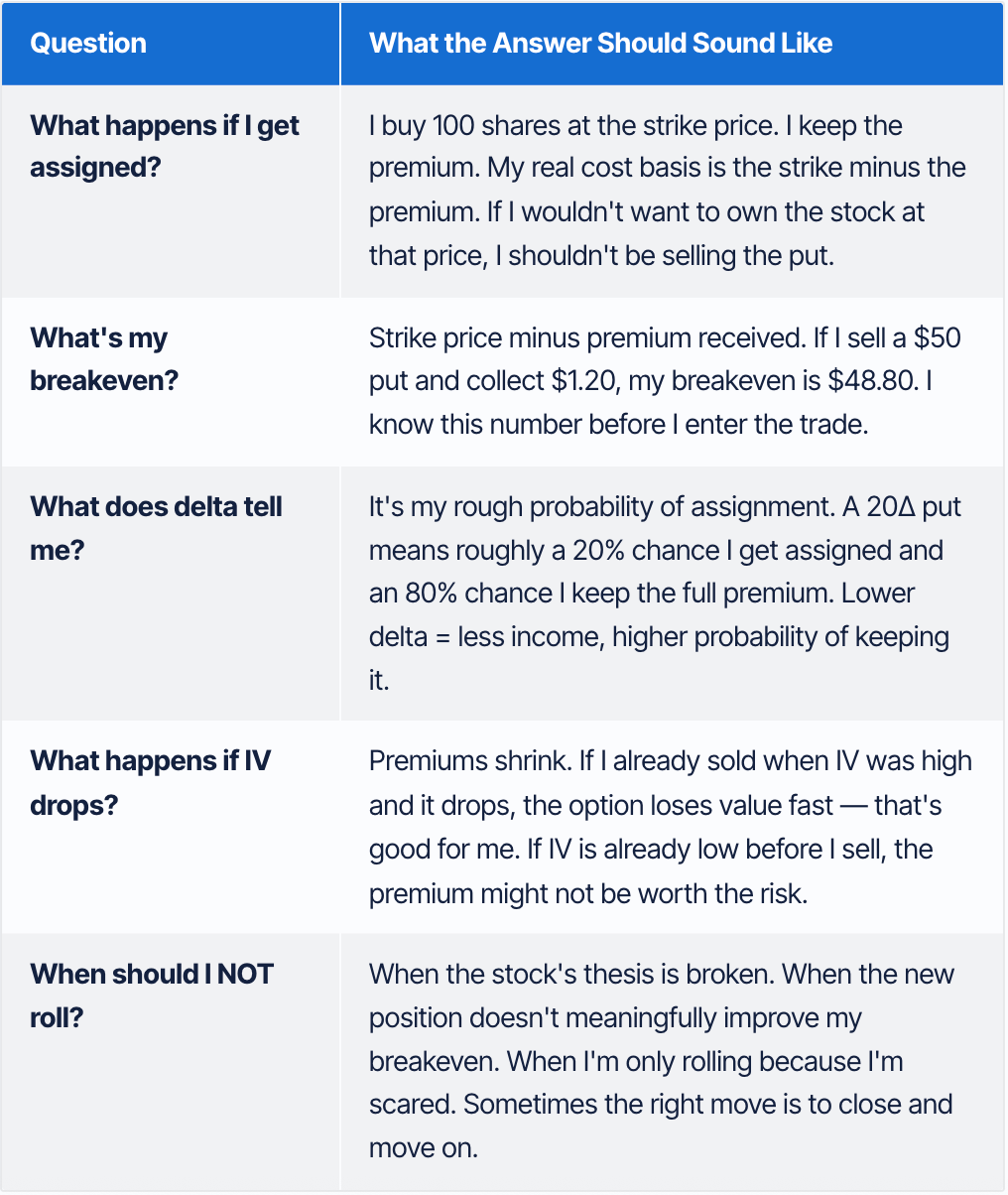
Here are five questions.
If you can answer them clearly - without looking anything up - you’re in good shape. If you hesitate on more than one, that’s your signal to study more before going live.
2. Capital Structure Readiness
The capital you use for options is not your whole portfolio.
It’s one piece - the Income Sleeve.
In a well-structured retirement portfolio, you’d also have dividend growth stocks, high-yield value holdings, and T-Bills doing their own jobs.
The options sleeve sits alongside those pillars, not instead of them.
How much you allocate depends on your experience and comfort level.
A common range is 20-40% of a total portfolio, but start with what lets you sleep well.
Before you place a trade, you should be able to say yes to all four:
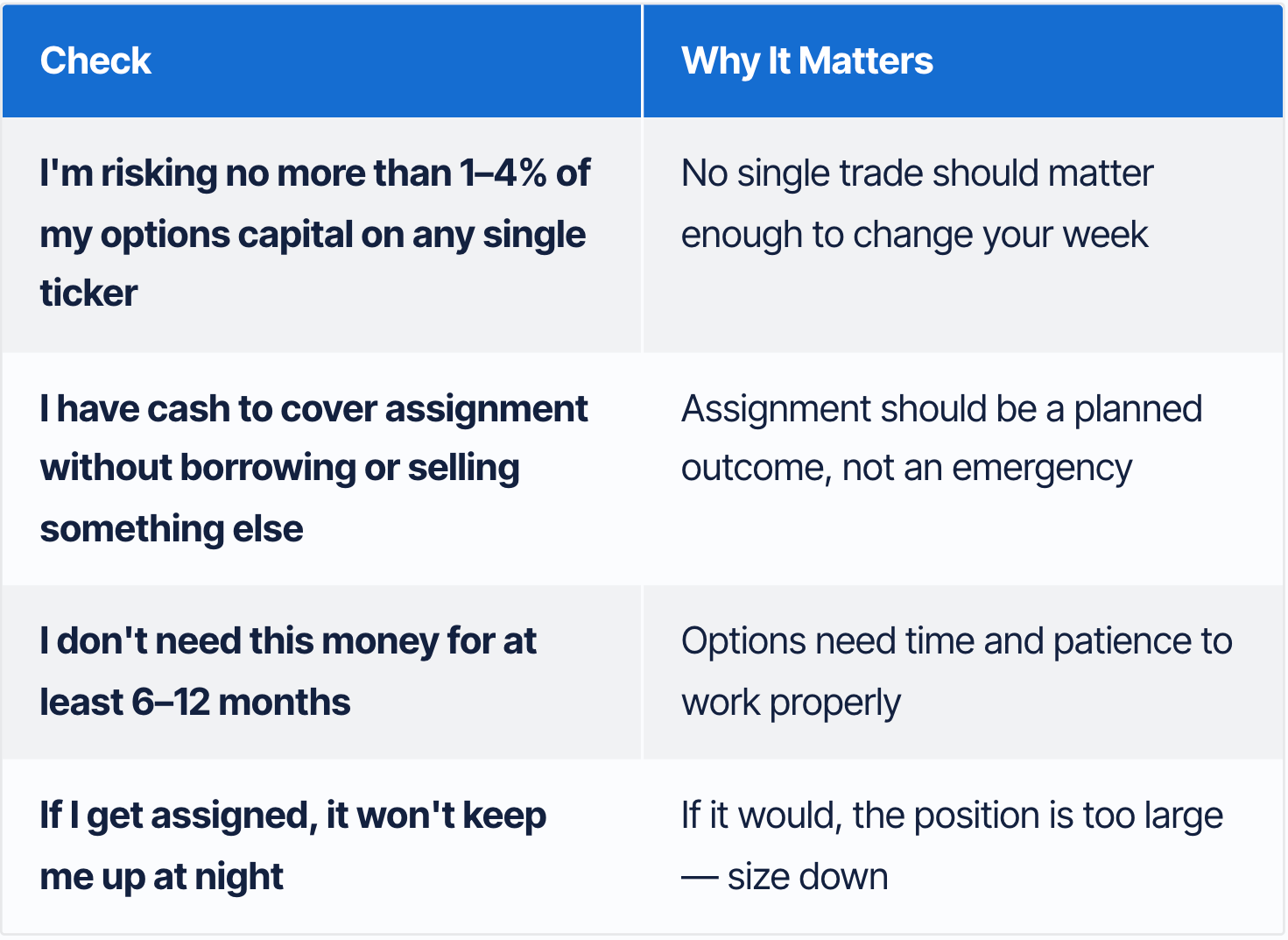
At 2% per position, that means $1,500 on a $75K sleeve, $3,000 on $150K,
or $6,000 on $300K.
Enough to be meaningful.
3. Psychological Readiness
This is where most people find out they’re not ready yet.
That’s fine - better to find out here than with money on the line.
Let me show you what this looks like in practice.
You sell a cash-secured put at the $48 strike, collect $1.30 in premium.
The stock was at $52.
Clean setup.
Two weeks later, the market pulls back.
Stock drops to $46.
Your broker shows the position in red.
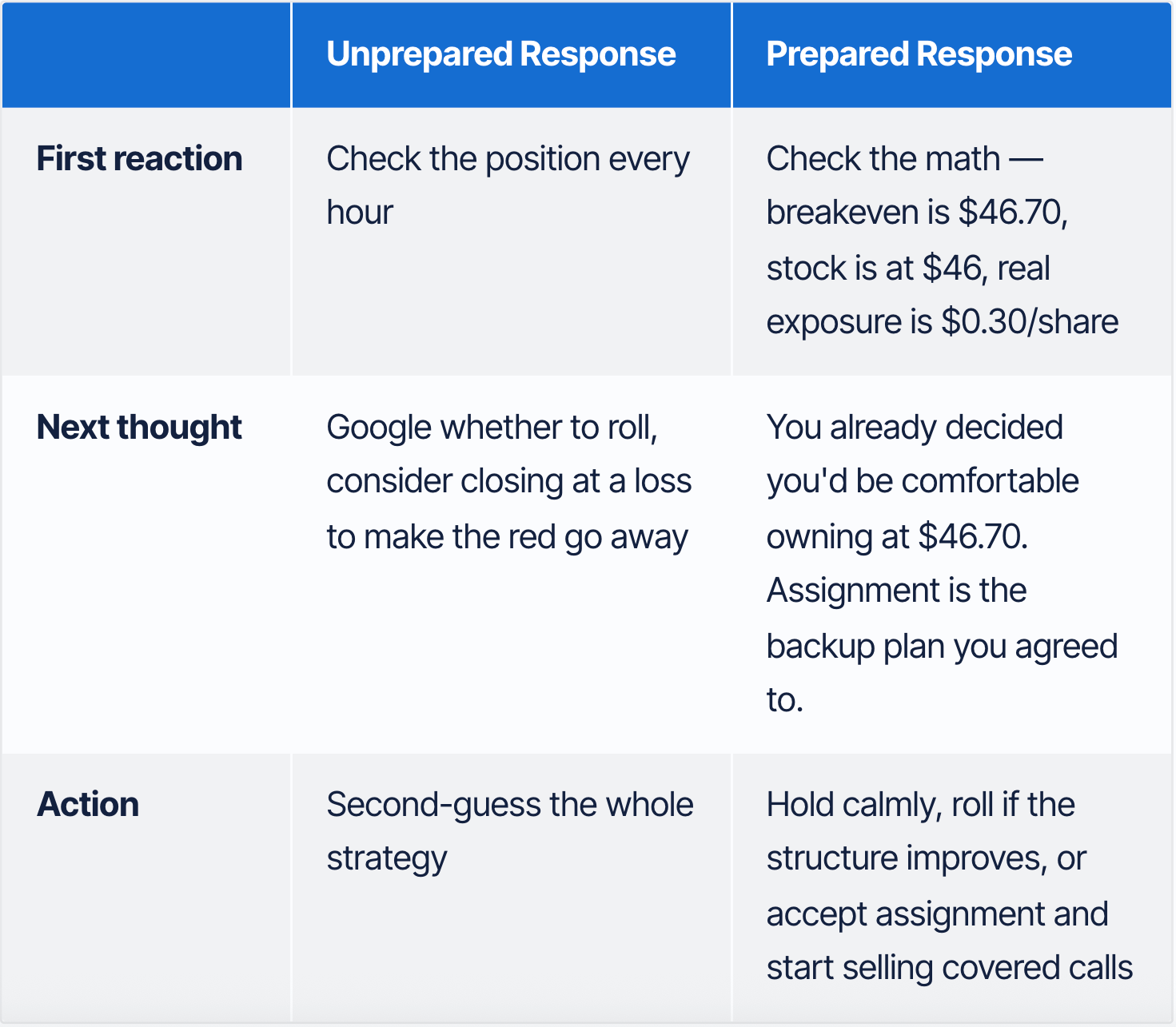
Same trade.
Same numbers.
Completely different experience.
Ask yourself honestly:
Can I watch a stock drop 10% and not panic?
Can I let assignment happen calmly?
Can I stick to my rules when a stock blows past my call strike and I miss the upside?
Can I avoid rolling just because I’m nervous?
The people who do well at this aren’t smarter.
They’ve decided ahead of time how they’ll respond.
4. Process Readiness
There’s a difference between understanding how options work and having an actual process for trading them.
Before your first live trade, these five things should exist - written down, not just in your head:
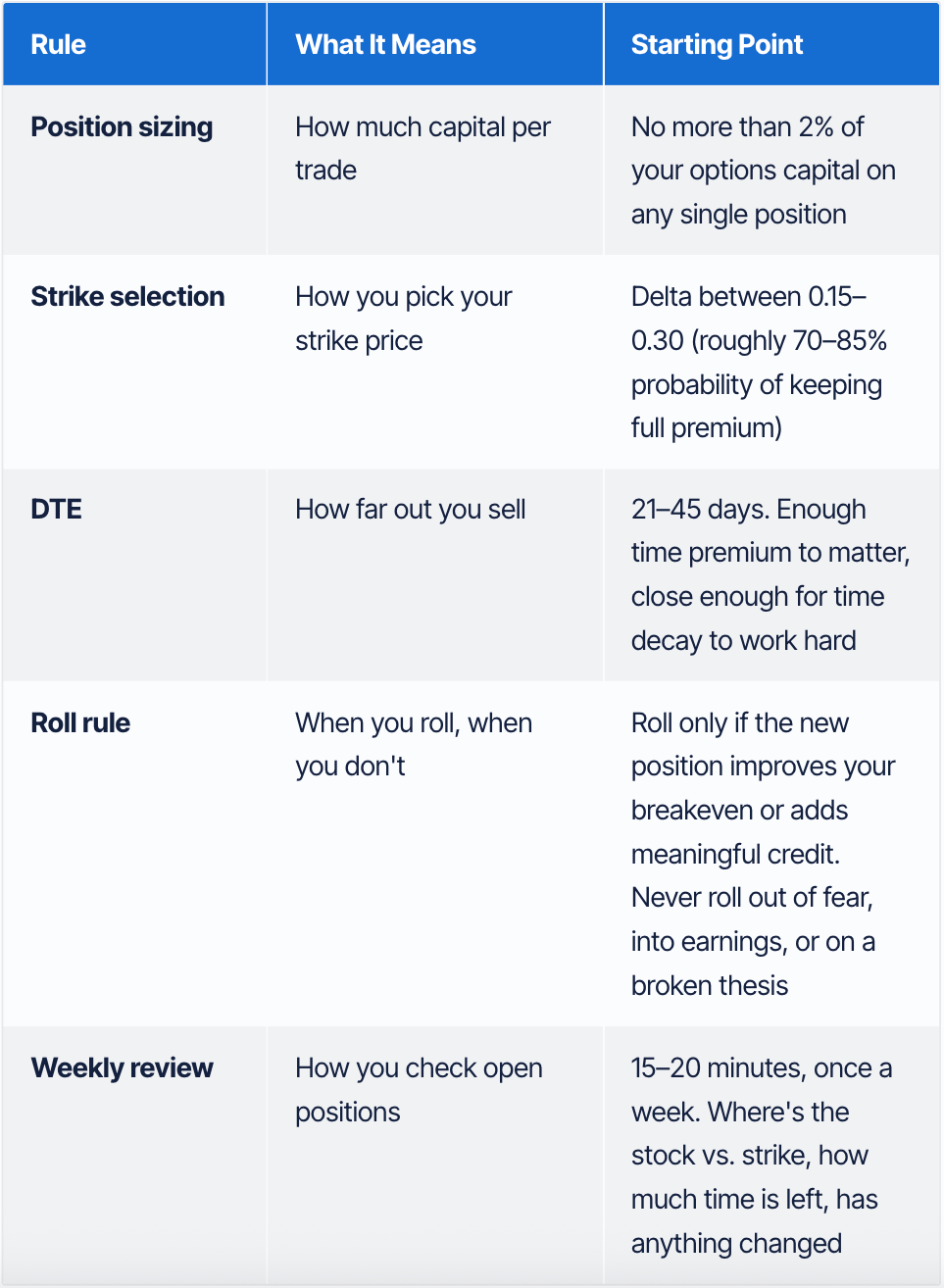
If any of these are missing, you’re making decisions on the fly. And making it up with real money is how small mistakes become expensive ones.
Inside The Multiplier, this is exactly the rhythm we follow - Monday Options Selling Plan, daily filtered trades from VADER, and a full Sunday review of every open position with management decisions.
That weekly loop is what turns individual trades into a repeatable process.
5. Expectation Readiness
This is the one that protects you from yourself.
Selling options for income is not a way to get rich.
It’s a way to generate steady, repeatable cash flow from stocks you’d want to own anyway.
And the options sleeve is one part of your overall portfolio - the income it generates stacks on top of your dividends, high-yield holdings, and T-Bill interest.
Here’s what realistic targets look like for the options sleeve alone:
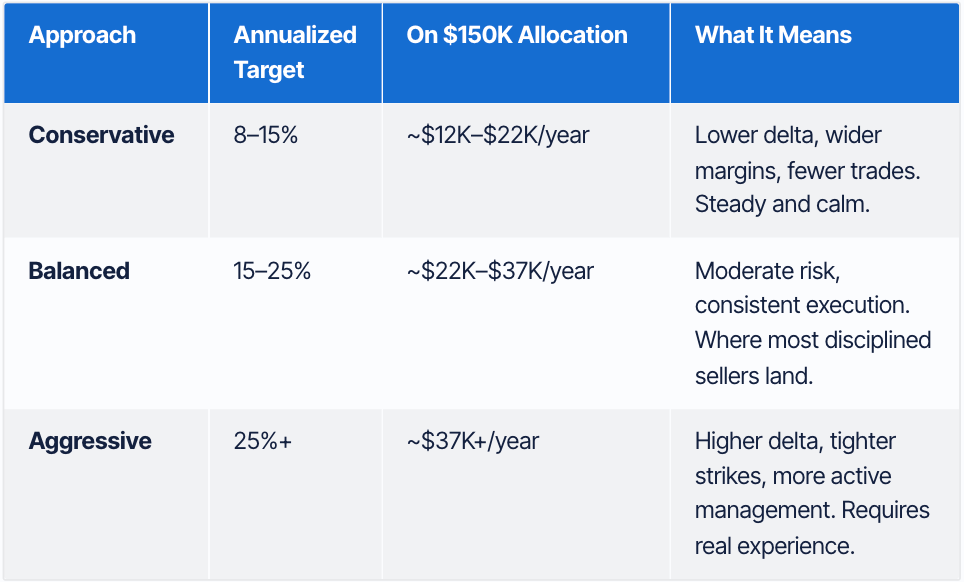
That’s $22K–$37K a year from options alone - before a single dividend lands or a T-Bill matures. You don’t need to chase aggressive returns when the rest of your income plan is already working.
The problem comes when expectations are too high.
Someone aiming for 50% will oversize positions, sell strikes that are too aggressive, skip the rules, and blow up a trade that didn’t need to be blown up.
A month that delivers 1–2% in premium income isn’t boring - it’s exactly what a well-run income sleeve looks like. Twelve of those months in a row is how you build something sustainable.
The “Go Live” Test — 10 Questions
You’ve been through the five readiness checks. Now score yourself.
Ten statements. Yes or no.
Be honest - this only works if you are.
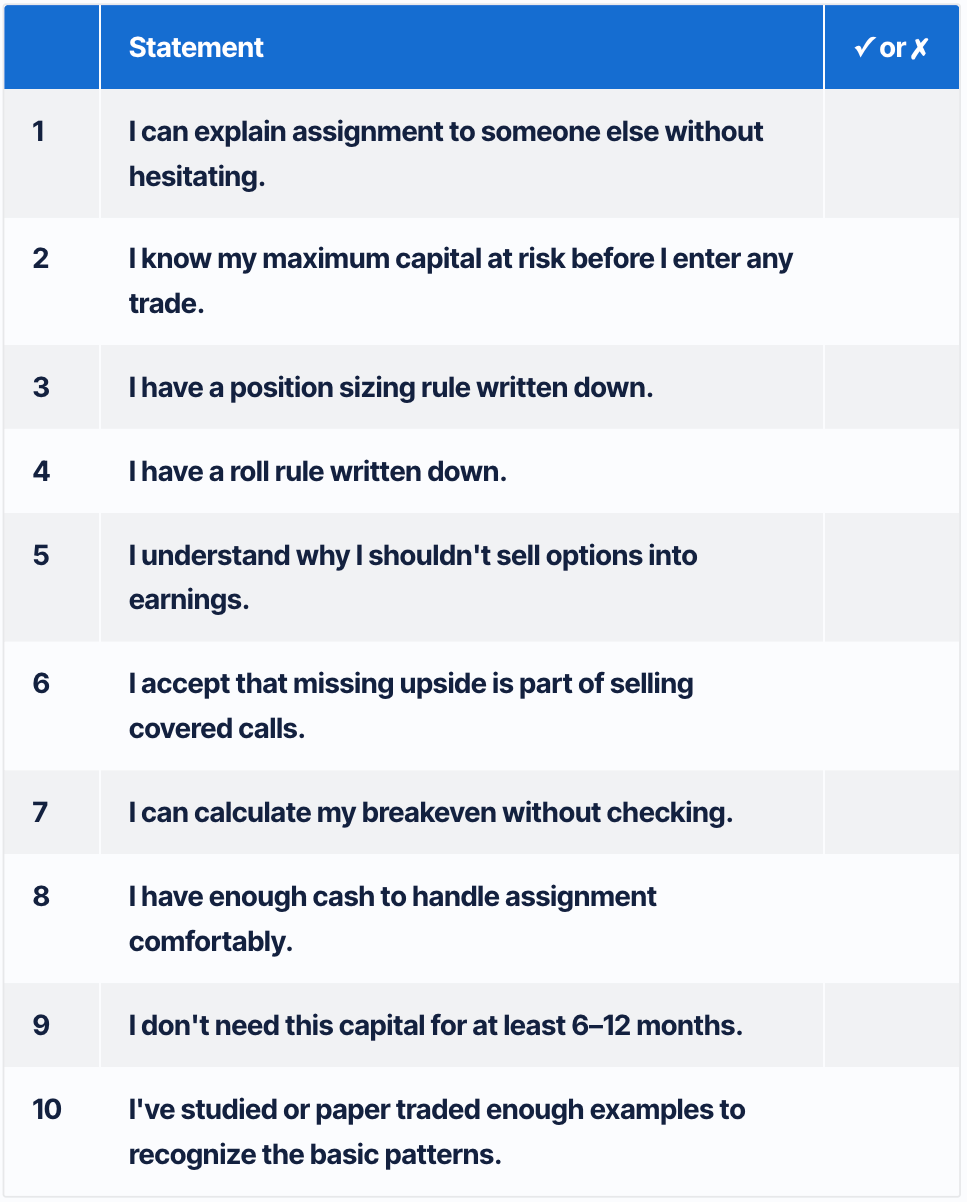
If you’d like to save or print this checklist, you can download it below.

Your score:
8–10: You’re ready. Start small, follow your rules, and review weekly.
5–7: Paper trade first. Study real trade examples until the patterns feel familiar. The Sunday Trading Lab recaps are built for exactly this - real positions, real decisions, real management logic you can follow along with.
Below 5: More foundation work needed. Go through the Cash-Secured Put and Covered Call Complete Guides first. No rush - the market will be there when you’re ready.
The whole point of this test is knowing where you stand before you risk real money. That clarity is worth more than any single trade.
Now that you know where your knowledge gaps are, you can fill them by reading the complete guides on selling options through this link.
Every experienced options seller I know has the same story.
They didn’t start by finding the perfect trade.
They started by being honest about what they didn’t know yet.
That’s all this test is.
A way to check - before your capital is on the line - whether you’ve done the work that separates a confident first trade from an expensive lesson.
If you’re not there yet, good.
Now you know exactly where the gaps are.
Close them first.
The market isn’t going anywhere.
Found this useful? Hit the ❤️ button. It helps more people like you find The Multiplier.
Do you have any questions? Feel free to email me at mike@themultiplier.co.
Thank you for reading and for being a part of The Multiplier.
— Mike